
The Japan International Cooperation Agency (JICA) is Japan’s principal agency responsible for implementing Official Development Assistance (ODA), working to promote international cooperation with developing countries. Guided by its mission to promote human security and quality growth, JICA operates under four thematic pillars aligned with the SDGs — “People,” “Planet,” “Prosperity,” and “Peace.” Within this framework, JICA has established 20 thematic strategies known as JICA Global Agenda (JGA). This agenda provides a strategic direction for JICA’s work with domestic and international partners toward a free, peaceful, and prosperous world. Within the JGA, JICA has designated “Sport and Development” as a key theme to promote inclusive societies that leave no one behind, using sport as a means for international cooperation.
Why JICA Focuses on “Sport and Development”
Sport has long been recognized as a fundamental right, particularly in European countries. In 1978, UNESCO adopted the International Charter of Physical Education and Sport, which states that “The practice of physical education and sport is a fundamental right for all”. Furthermore, the 2030 Agenda for Sustainable Development, adopted by the United Nations in September 2015, explicitly recognizes that:
“Sport is also an important enabler of sustainable development. We recognize the growing contribution of sport to the realization of development and peace, in its promotion of tolerance and respect, and the contributions it makes to the empowerment of women and of young people, individuals and communities as well as to health, education and social inclusion objectives.”
The international community expects sport to contribute to achievement of the SDGs, particularly in Good Health and Well-being (Goal 3), Gender Equality (Goal 5), and Peace, Justice and Strong Institutions (Goal 16).
Within the JGA, JICA emphasizes “Sport and Development” with the vision of building “a peaceful world where everyone can enjoy sport.” JICA sees sport-based international cooperation as consistent with Japan’s development philosophy, which regards human development as encompassing mental well-being. JICA promotes the transformative power of sport to foster both individual growth and community development.
JICA’s activities in this field are built on two complementary approaches:
1. Development of Sport – Promoting and strengthening sport itself as a sector for development.
2. Development through Sport – Using sport as a means to tackle broader development challenges.
Under these two approaches, JICA has established three key pillars of action.
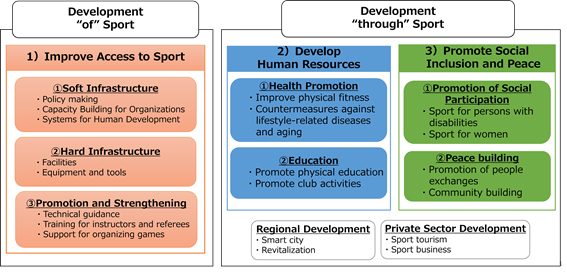
Improving Access to Sport: Examples from “Development of Sport”
To enhance access to sport in developing countries, JICA focuses on expanding participation opportunities and sharing the value and enjoyment of sport through initiatives in soft infrastructure, hard infrastructure, and sport promotion and capacity development. Here are some examples of these efforts.
Example 1: Soft Infrastructure – “Sport Administration / Sport Promotion” Knowledge Co-Creation Program
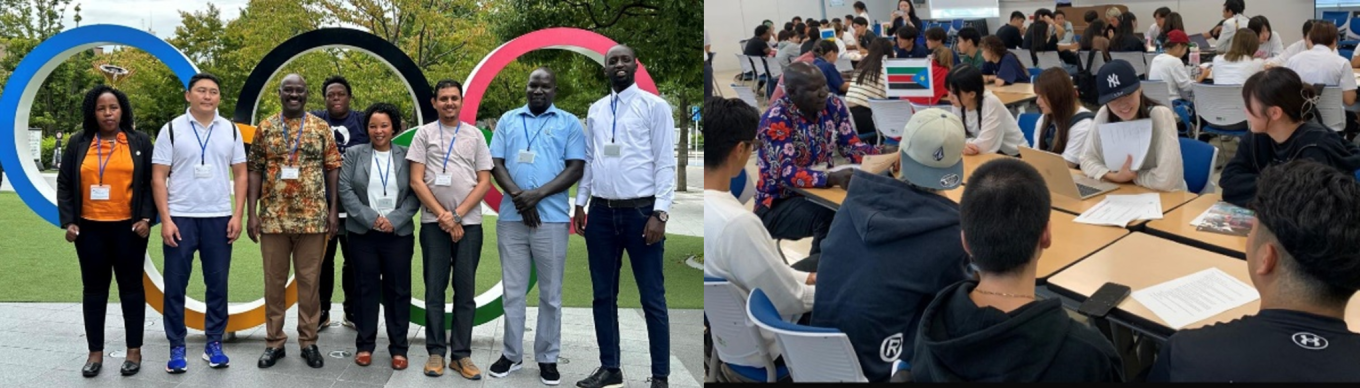
Knowledge Co-Creation Programs are developed and delivered by Japan for administrative officers and practitioners from partner countries. They cover a wide range of topics, drawing on Japan’s knowledge and experience to help tackle challenges faced by developing nations. In FY2024, JICA introduced a new course titled “Sport Administration / Sport Promotion”. This program focuses on three objectives: building policies and institutional frameworks (soft infrastructure), improving facilities and environments for sport (hard infrastructure), and training instructors and coaches (sport promotion and capacity building).
In October 2024, eight participants from Yemen, Uganda, Grenada, Tanzania, Burkina Faso, South Sudan, Mongolia, and Rwanda took part in the course. The program featured presentations on each country’s current policies, lectures by the Japan Sports Agency, Japan Sport Council, and Japan Sports Association, and visits to the Kodokan Judo Institute, Giants Baseball Academy, and Nippon Sport Science University. Participants also engaged in hands-on learning through activities such as blind soccer and judo. One participant commented, “I was able to experience the diversity of sport and understand how sport can contribute to education and society.“
On the final day, each participant outlined an action plan for improving sport administration in their home country, incorporating lessons learned from the training and site visits. The program enabled participants to develop fresh insights and practical ideas for policy reform and community development through sport.
Example 2: Soft Infrastructure – Support for Physical Education in Cambodia
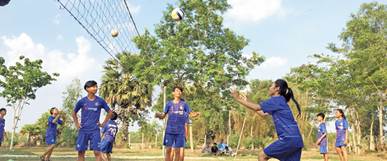
Since 2006, the NPO Heart of Gold has worked to improve physical education in Cambodia through “JICA Partnership Program” framework. When the project began, physical education (PE) classes were limited to basic movement known as “Khmer exercises,” with no standardized curriculum or teaching materials. Through the project, a national PE curriculum was developed in 2007, followed by its implementation in selected pilot schools.
The initiative continued to grow over the years. By 2020, teaching guides for primary and lower secondary schools and curricula for middle and high schools were completed and officially endorsed by the Cambodian Ministry of Education. Since 2021, the new PE curriculum has been implemented in all schools across three provinces, improving the quality of PE and allowing more children to experience the joy of sport.
Example 3: Hard Infrastructure – Official Development Assistance Grants “The Project for the Reconstruction of the Chao Anouvong Stadium” in Laos
Built in 1950 in the center of Vientiane, the Chao Anouvong Stadium has long hosted major sports competitions—including football, rugby, and para-athletics—along with community events. However, severe deterioration and a lack of essential equipment had made it difficult to ensure the safe use of the facility—especially for persons with disabilities—and had also hindered smooth facility operations..
Through Japan’s grant aid, the stadium and its auxiliary facilities were renovated, new equipment was installed, and training on facility operation and maintenance was conducted both locally and in Japan. Manuals in the Lao language were also developed to support sustainable, autonomous maintenance of the facilities.
Through this cooperation, enhancements to accessibility and safety are expected to promote greater use of the stadium by athletes and a wide range of citizens. In addition, the cooperation is expected to encourage the social participation of persons with disabilities, promote sport and cultural activities, and contribute to the development of the urban environment.
Example 4: Promoting Sport – JICA Volunteer Program (Sport Volunteers)
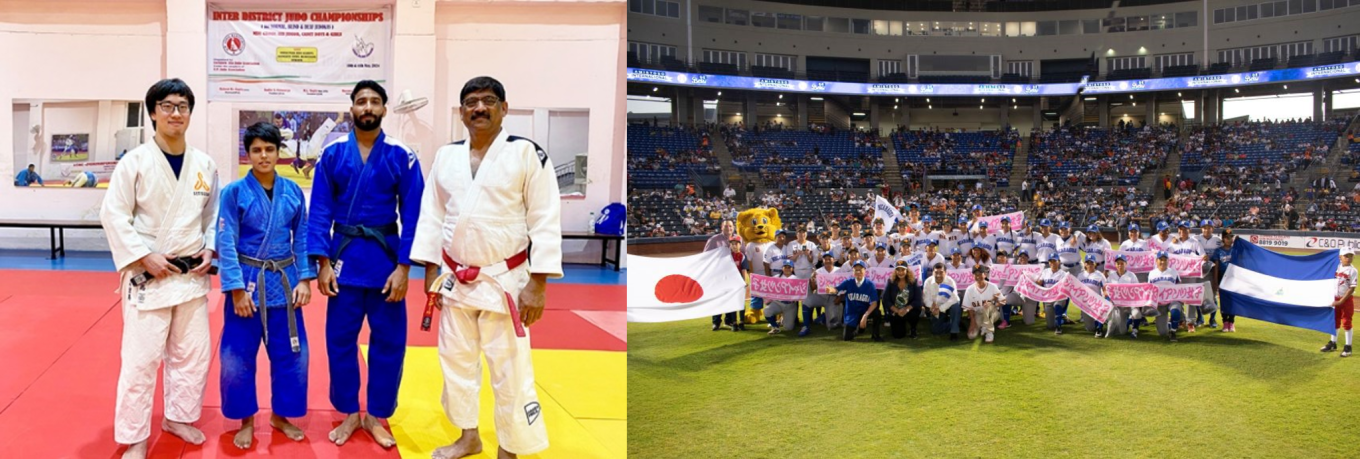
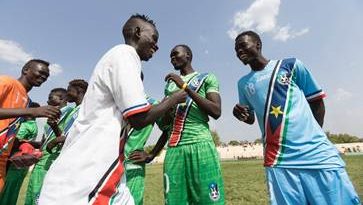
Since the launch of the Japan Overseas Cooperation Volunteers (JOCV) in 1965, JICA has sent sport volunteers worldwide. As of March 2024, a total of 3,363 volunteers across 28 sport disciplines have been deployed, supporting national teams, promoting grassroots sports, and advancing physical education. (Visit JICA Overseas Cooperation Volunteers website)
At the Paris 2024 Olympic and Paralympic Games, 20 athletes from 13 countries who had been coached by JICA volunteers competed, including Kapil Parmar from India, who won a bronze medal in the men’s 60kg judo event for visually impaired athletes.
(Related article available here)
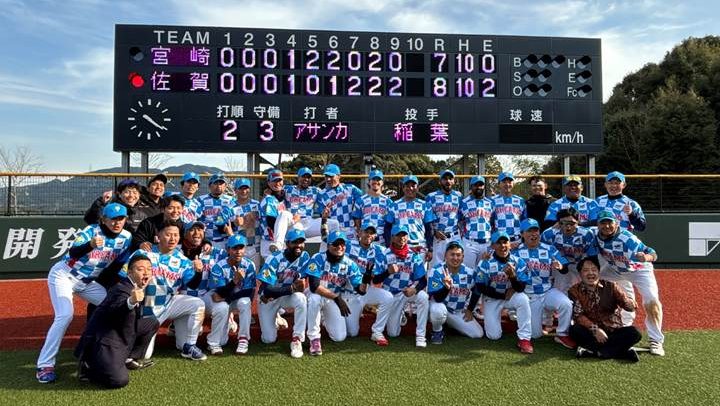
In partnership with the Yomiuri Giants, JICA also dispatched coaches to Brazil and Nicaragua to promote baseball development. In Brazil, the initiative strengthened ties with the Japanese-Brazilian community, while in Nicaragua, the Giants’ women’s team held friendly matches with local women’s teams, helping to promote women’s baseball. These efforts have strengthened cultural exchange and fostered community engagement through sport.
In the second part of this series, we will introduce “Development through Sport”—how JICA uses sport as a tool to address broader development challenges.
Learn more:
- JICA “Sport and Development” Website
- Video: JICA’s “Sport and Development” Initiatives
OGAWA Nao
Japan International Cooperation Agency (JICA)
Secretariat of Japan Overseas Cooperation Volunteers, Program Operation Division
Officer in charge of “Sport and Development”
After graduating from university, Mr. Ogawa served in El Salvador as a JOCV Kendo instructor starting in 2019, working to promote and teach kendo nationwide. After returning to Japan in 2020 due to COVID-19, he completed graduate studies and joined JICA’s Private Sector Partnership and Finance Department in June 2022. Since June 2023, he has been serving as the “Sport and Development” officer at the Secretariat of JOCV, overseeing JICA’s initiatives in this field.
*Titles and affiliations are as of March 2025
Note: This article was originally published in Japanese on May 15, 2025. The original article can be accessed here.